
Do you need a plumbing leak test after foundation repair in Cibolo?
Yes, it is a smart step. Lifting or leveling a slab can bend, crack or pull apart the water and sewer pipes inside it. A plumbing test after foundation repair checks the sewer line and the water lines for new leaks, so you catch damage early instead of months later on a water bill or a cracked floor.
Cibolo homes sit on expansive clay that swells after heavy rain and shrinks in long, dry summers. That movement is why so many homes in Cibolo, Schertz and the rest of northeast Bexar and Guadalupe County need foundation work, and it is also why their plumbing takes a beating. If you need a test booked, our leak detection in Cibolo, TX team can usually come out within a day or two.
Why does foundation repair affect your plumbing?
Your water lines and sewer drain run under or inside the slab. When a foundation crew raises a low corner with piers, the slab moves, and the pipes move with it. Rigid pipes like cast iron sewer lines and older copper water lines can crack at joints, and a sewer line can lose its slope so waste no longer flows well.
Most of the time the pipes come through fine. But a crack in a buried sewer line does not leak where you can see it. It leaks into the soil under your house, which can soften the ground the new piers depend on. That is why many foundation companies recommend a plumbing test before and after the job.
- Sewer lines can crack, separate at joints or develop a sag or "belly".
- Water supply lines can crack or pull at fittings, especially old copper or galvanized pipe.
- Hot water lines are the most likely to show a slab leak later, often as a warm spot on the floor.
Which plumbing tests should you ask for?
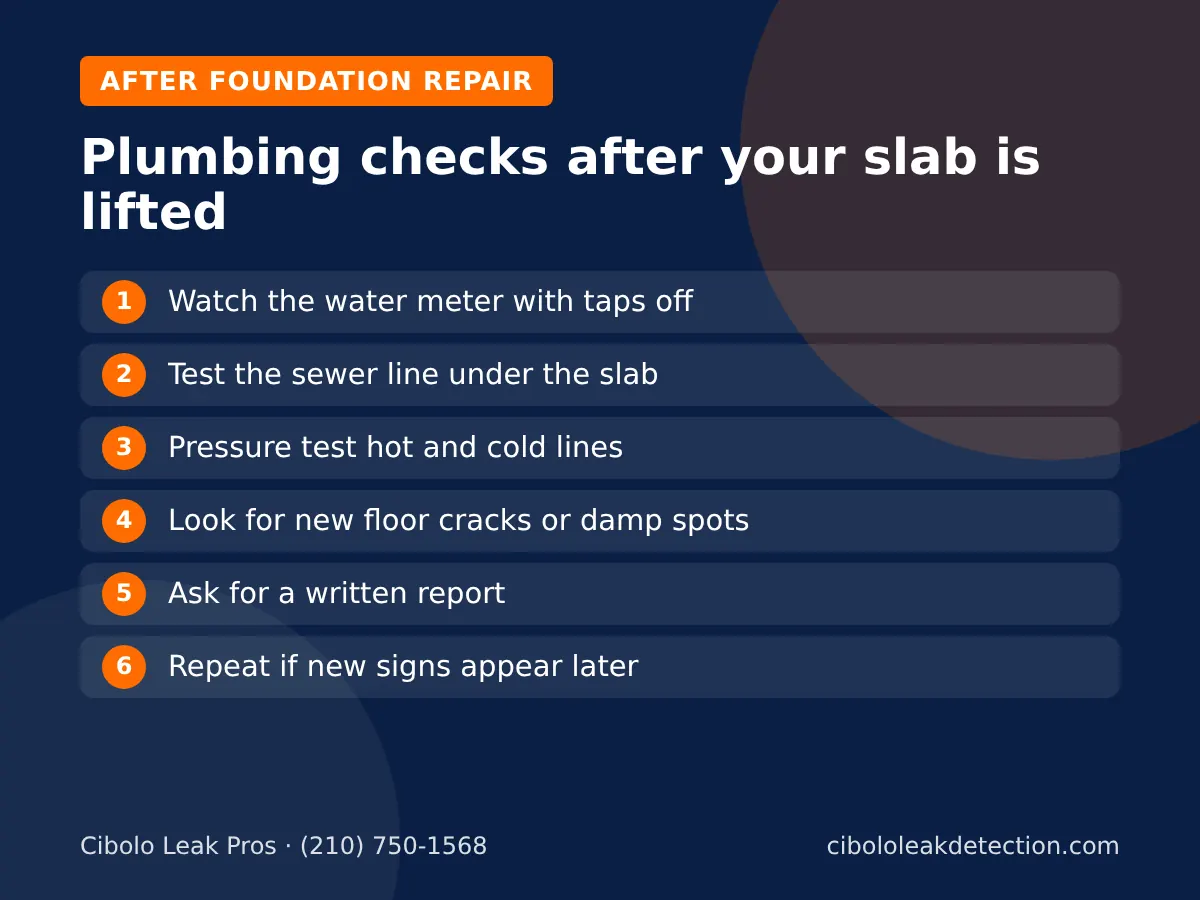
Ask for two things: a sewer line test and a water line pressure test. The sewer test, often called a hydrostatic test, fills the drain line under the slab with water and watches the level to see if it drops. The water line test pressurizes the supply lines and watches for pressure loss. A camera inspection of the sewer adds a view of cracks and sags.
| Test | What it checks | What it tells you |
|---|---|---|
| Sewer hydrostatic test | Drain lines under the slab | Whether the sewer holds water or leaks into the soil |
| Water line pressure test | Hot and cold supply lines | Whether a supply line is losing water |
| Sewer camera inspection | Inside of the drain line | Where a crack, root or belly is |
| Meter check | Whole water system | A quick sign that water is leaving somewhere |
If a test fails, the next step is pinpointing the spot with acoustic and thermal tools so the repair needs only one small opening. Our guide to finding a hidden water leak explains how that works.
Should you test before or after foundation repair?
Ideally both. A test before the work shows whether a plumbing leak is part of what caused the foundation to move, and it gives you a baseline. A test after the work shows whether lifting the slab damaged anything. If you only do one, do the test after, ideally within a few weeks of the lift.
- Before: a leaking sewer under the slab can wash out or swell the soil and cause the settling you are fixing. Fix that first, or the problem can come back.
- After: confirms the lift did not crack a line. Many foundation warranties expect you to report plumbing damage quickly.
- Later: if new signs appear months after the work, test again before assuming the foundation failed.
Ask your foundation company whether their contract mentions plumbing tests or plumbing damage. Some require a test before they start. Keep the reports with your foundation paperwork.
What are the signs of plumbing damage after foundation work?
Watch for a water bill that jumps, a meter that moves with every tap off, slow drains or gurgling in several fixtures, sewer smell inside, a warm or damp spot on the floor, and new cracks in tile or drywall. Any one of these in the weeks after a lift is worth a test.
- Your water bill went up with no change in use. See common high water bill causes.
- Several drains are slow, or toilets gurgle when the washer drains.
- You smell sewer gas in a bathroom or near the kitchen.
- A tile or wood floor feels warm in one spot.
- New cracks or damp baseboards appear along one wall.
Our full list of slab leak signs covers what to look for room by room.
What does a plumbing leak test cost in Cibolo?
A leak detection visit for house lines in Cibolo usually costs about $150 to $450. Testing several lines under the slab runs about $250 to $600. A sewer test is quoted with the visit, since it depends on how many drain lines and access points the house has. Repairs are priced separately once a leak is found.
| Job | Typical range |
|---|---|
| Leak detection visit (house lines) | $150 – $450 |
| Slab leak detection, several lines | $250 – $600 |
| Slab leak spot repair (incl. concrete patch) | $1,000 – $4,000 |
| Slab line reroute | $1,500 – $5,000 |
Ranges are approximate 2026 estimates for the Cibolo and northeast San Antonio area. They are not quotes. You get the price before any testing starts.
What happens if the test finds a leak?
The technician pinpoints where the line is broken, marks it, and gives you a written report. Then you decide on the repair: a small opening in the slab, a reroute that avoids the slab, or a tunnel under it for sewer work. Share the report with your foundation company and insurer before the repair starts.
- Supply line leak: often fixed with a spot repair or a reroute through the walls or attic.
- Sewer line crack or belly: may need a section replaced, sometimes by tunneling to avoid breaking floors.
- Insurance: some policies cover access and water damage but not the pipe. See does insurance cover slab leaks.
When a repair is needed, our slab leak repair in Cibolo page explains each option. We also serve leak detection in Schertz, Converse and Universal City, where the same clay soil causes the same foundation and plumbing problems.
Related
- Leak detection services
- Water line leak detection
- 8 Signs of a Slab Leak
- How to choose a leak detection company